





UVA LED Mosquito Lamp Tubes for Europe's 2026 Crisis
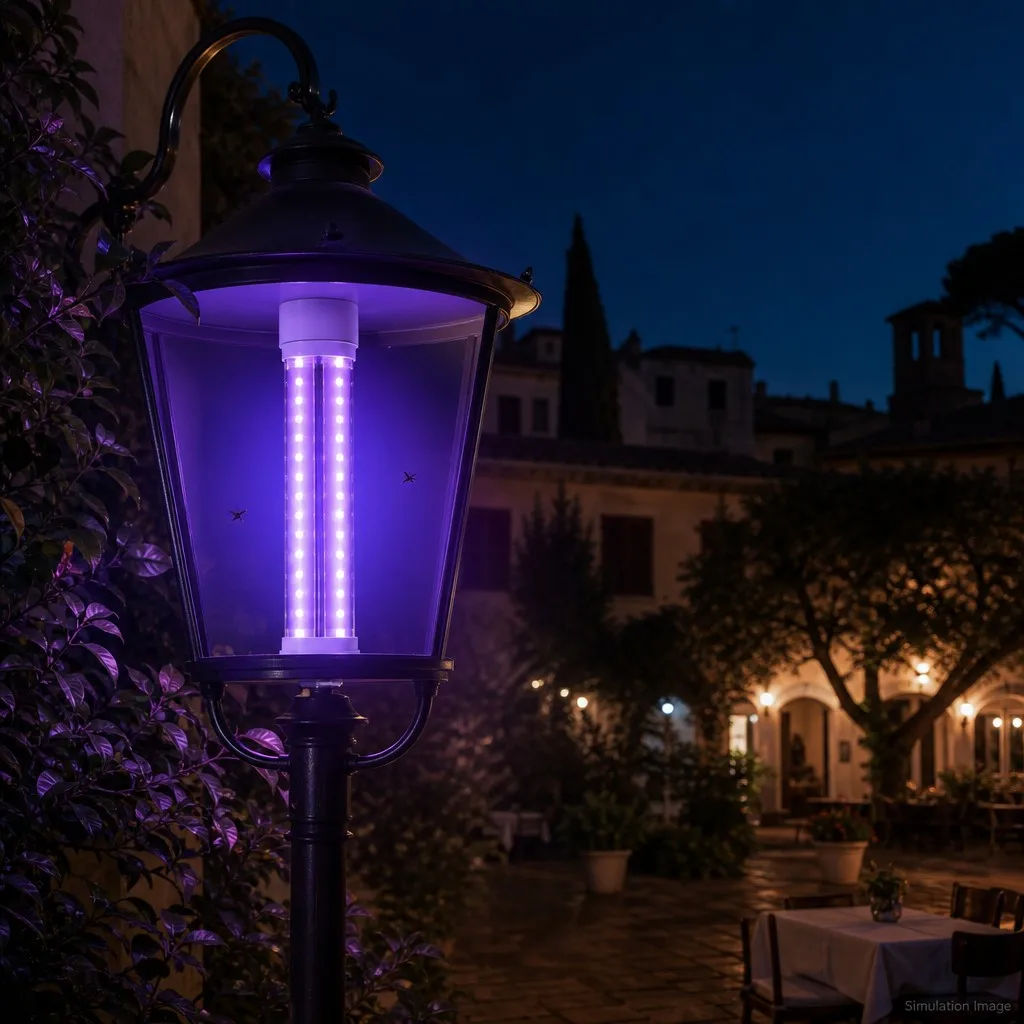
Europe's 2026 Mosquito Crisis: What Rome's Outbreak Means for Mosquito Control — and the UV LED Lamp Tubes Built for the Response
The 2026 Outbreak in Numbers
Italy recorded the heaviest WNV burden in the EU/EEA in 2025: 779 confirmed cases and 72 deaths, a case-fatality rate of 9.2% — the highest in the European Union (source: Italian national surveillance, 2025 annual data). The 2026 season is following the same curve. As of 22 July 2026, Italy reported 46 locally acquired WNV cases, the most in Europe, ahead of Greece with 21 (source: ECDC weekly surveillance, 22 July 2026).
The Lazio region around Rome is the hotspot: as of 26 August 2026, Lazio had confirmed 63 cases with new reports across multiple Rome health districts, and nearly half of patients developed severe neuroinvasive forms such as encephalitis or meningitis (source: Lazio regional health authorities, 26 August 2026). National reporting through late August 2026 put the seasonal total in the hundreds with 17 deaths (source: aggregated news reporting, late August 2026).
Two other arboviruses are part of the same picture: Italy reported 384 locally acquired chikungunya cases in 2025 across Emilia-Romagna, Veneto, Tuscany and Lazio, and the Marche region's 199 locally acquired dengue cases in 2024 set a European record for a local outbreak.
Two Vectors, Two Daily Rhythms
| Vector | Diseases | Biting pattern | Breeding & spread |
|---|---|---|---|
| Culex pipiens (common house mosquito) | West Nile virus | Dusk to night | Rice fields and wetlands of the Po Valley and similar humid areas |
| Aedes albopictus (Asian tiger mosquito) | Chikungunya, dengue, Zika | Daytime | Established in Italy since 1990; spread across the country and much of southern Europe |
Climate change is the force multiplying both. Warmer temperatures accelerate mosquito development and increase biting frequency; milder winters raise overwinter survival and lengthen the transmission season; and extreme weather — heat waves followed by heavy rain — creates new breeding sites in urban containers, drains and green spaces.
ECDC's framing: as the ECDC director has put it, Europe has entered a new phase in which longer transmission seasons, wider geographic spread and higher intensity of mosquito-borne disease are the new normal (source: ECDC statements, August 2026).
Who is affected — and why buyers are looking now
- Public health authorities and municipalities under ECDC pressure to strengthen mosquito control.
- Commercial and hospitality operators — hotels with gardens, restaurants with outdoor terraces, campsites, stables and farms — where biting insects mean complaints, brand risk and, in livestock areas, real WNV concern.
- Importers and brand owners supplying the European market, responding to surging consumer and business demand.
Where UV LED Mosquito Lamp Tubes Fit in the Control Toolbox
Mosquito control is never one tool. The standard response layers include:
- Personal protection — repellents and protective clothing.
- Source (breeding-site) management — removing or treating standing water where larvae develop.
- Chemical control — larvicides in breeding habitats and space spraying (fogging) of adult mosquitoes during peak transmission.
- Physical trapping — light-based attraction as a continuous, chemical-free layer that reduces adult mosquito pressure around people and property.
UV LED mosquito lamp tubes belong to that fourth layer. To be precise about what they do: they attract, trap and remove adult flying insects — they do not kill larvae, and they are not a stand-alone cure for an outbreak. Used correctly, they are a continuous physical layer that complements spraying and source control — during the dusk and night hours when Culex pipiens is active, and in the shaded indoor and under-cover spots where Aedes albopictus rests and bites by day.
Because the insects are attracted by light — not by smell or chemistry — the single most important specification is the peak wavelength of the tube. As explained in our guide to UV LED mosquito lamp tube color, what the tube looks like to a human eye is not the standard; the peak wavelength is. A narrow-band LED tube concentrates its energy at the wavelength that matters, instead of wasting it across a broad spectrum the way older blacklight tubes do.
The Product Layer: Tianhui UV LED Mosquito Lamp Tubes for the European Response
Tianhui has manufactured UV LED solutions for more than 23 years. As European importers and operators move from asking "is this real?" to "what do we order?", here is the product line built for the response.
Choosing the band: 365nm, or 365+395nm?
The two vector species in Italy's 2026 outbreak — and the broader European mosquito complex — show phototactic sensitivity in the UVA range around 365nm. That makes 365nm the natural primary attractant band for mosquitoes.
- Single-band 365nm is the targeted choice when mosquitoes are the dominant pest.
- Dual-band 365+395nm widens the attractant window to also cover flies, moths and other flying insects — useful in mixed environments such as restaurants, stables, waste collection points and outdoor hospitality.
The engineering rule mirrors our color communication guide: select by peak wavelength and by the pest spectrum of the site, not by how the tube glows.
The product range (reference specifications)
| Parameter | TH-UV365T8 Series | TH-UV365A60 Series |
|---|---|---|
| Lamp form | T8 tube | A60 bulb |
| Base / socket | G13 (bi-pin) | E27 (Edison screw) |
| Peak wavelength | 365nm (single band, mosquito-targeted) | 365 + 395nm (dual band: mosquitoes + flies/moths) |
| Power options | 5W / 7W / 10W | 5W / 7W / 10W |
| Glass finish | Clear (TM) / Powder-coated (PF) | Clear (TM) / Powder-coated (PF) / Frosted |
| Typical coverage | 20–60 m² (reference value — depends on model, power and installation) | 20–60 m² (reference value — depends on model, power and installation) |
| Drive | AC; wide-voltage 85–265V configurable | AC; wide-voltage 85–265V configurable |
*All coverage figures are reference values and must be validated for your specific space and installation.
- Clear glass (TM) transmits UV most efficiently — the strongest attraction performance, best used inside a shielded lamp housing.
- Powder-coated (PF) diffuses the light and reduces direct UV output — suited to environments where exposure should be minimized.
- Frosted (A60 series only) gives the most uniform diffusion with the lowest direct UV leakage.
European compliance: what to check before you import
For the EU market, the standard electrical configuration is AC 220–240V / 50Hz, and CE and RoHS compliance is mandatory. Two practical points for buyers:
- Ask for a wide-voltage (85–265V) drive option — it reduces SKU risk across multiple European countries and is available as a customization.
- Lamp certification and luminaire (fixture) certification are separate — a CE-marked lamp tube does not automatically make the complete lamp housing compliant. Verify the overall fixture compliance with your supplier.
Where the tubes work: application scenarios
- Indoor and covered semi-outdoor spaces — residential courtyards, restaurant terraces under cover, hotel gardens, warehouses, stable entrances and farm buildings.
- Under-cover public and commercial zones — where mosquitoes rest and bite during dusk and night hours (T8, 365nm, targeted).
- Mixed-pest commercial sites — kitchens, waste collection points, animal housing — where flies and moths ride along with mosquitoes (A60, 365+395nm, broad-spectrum).
Important: for exposed outdoor or wet installations, the ingress-protection (IP) rating and waterproofing solution must be confirmed with the factory, or the lamp should be used inside a purpose-built waterproof luminaire. Tianhui does not quote a blanket outdoor waterproof rating for the bare lamp tubes — confirm the configuration for your site.
OEM and private label for European importers
- Custom LOGO printing (lamp body and packaging)
- Multilingual packaging (English, French, Spanish, German, Arabic and others)
- Plug and base type adjustments within existing socket standards
- Wavelength switching between 365nm and 365+395nm
- Glass-finish switching (TM / PF / frosted on the A60 series; TM / PF on the T8 series)
Custom MOQ and lead time apply, and some non-standard requests require factory evaluation — confirm the details with our team before ordering.
Why Tianhui
With more than 23 years of UV LED manufacturing experience, Tianhui builds the lamp tubes behind this response with the same discipline across wavelengths, glass processes and drive electronics. Whether you need a targeted 365nm T8 line for mosquito-dominant sites or a dual-band A60 line for mixed environments, the configuration, compliance documentation and OEM program are confirmed with our engineering team — not guessed at.
Frequently Asked Questions
Q1: Can a UV LED mosquito lamp tube stop a West Nile outbreak?
No single device can. Lamp tubes are a physical trapping layer that reduces adult mosquito pressure around people and property; an outbreak response also requires breeding-site management, chemical control where appropriate, and personal protection. Never assume a specific catch or reduction rate — validate performance in your own setting.
Q2: Is 365nm or 395nm light a sanitizing wavelength?
No. 365nm and 395nm are UVA wavelengths used for insect attraction and trapping. Germicidal UV is a different band entirely — UVC sources around 253.7nm (and Uvc Leds at 265/275nm) — which this product does not emit. These lamp tubes are for insect trapping only.
Q3: Which tube should I choose — 365nm or 365+395nm?
If mosquitoes are the dominant pest, the 365nm T8 series is the targeted choice. If the site also has flies, moths or other flying insects — restaurants, stables, waste points — the 365+395nm A60 series gives broader-spectrum attraction.
Q4: Can the tubes attract flies and moths too?
The 365+395nm dual-band A60 series is designed for a broader flying-insect spectrum including flies and moths. The single-band 365nm T8 is optimized for mosquitoes. Match the band to the pest mix of your site.
Q5: How large an area does one tube cover?
Coverage is typically in the 20–60 m² range depending on model, power and installation (reference value). Validate the spacing and mounting for your specific space with your supplier.
Q6: How long do the lamp tubes last?
The tubes carry a long rated operating life — refer to the specification sheet for the exact rating for your model and drive configuration. Actual service life depends on operating environment and duty cycle.
Q7: Can I use these tubes outdoors in Europe? Are they CE/RoHS compliant?
The EU configuration is AC 220–240V / 50Hz with CE and RoHS compliance. For exposed outdoor or wet locations, the IP rating and waterproof housing must be confirmed with the factory or provided by the luminaire — do not assume the bare tube is outdoor-rated. Also verify overall fixture compliance, since lamp and luminaire certifications are separate.
Q8: Is the UV light safe?
365nm UVA can be irritating to eyes and skin with prolonged direct exposure — avoid looking directly at the source and do not enter the lamp coverage area unnecessarily while it is operating. These tubes are for insect trapping only; never use them for human exposure or direct illumination of food. In homes with children or pets, choose powder-coated or frosted versions to reduce direct UV output.
Q9: Do you support OEM/private label for European importers?
Yes — LOGO printing, multilingual packaging, plug adjustments, wavelength switching (365 ↔ 365+395nm) and glass-finish changes are available. Custom MOQ and lead time apply; confirm your program details with our team.
Conclusion
Rome's 2026 West Nile season is the latest signal that mosquito-borne disease is now a European operating condition, not a southern summer anomaly. The response will need every layer — source control, chemistry, personal protection, and continuous physical trapping. For importers, operators and public buyers sourcing the tools of that response, the UV LED mosquito lamp tube is the product question of the season, and the answer starts with the peak wavelength.
Related reading: UV LED Mosquito Lamp Tube Color: How to Explain It to Your Customers — why peak wavelength, not color, is the performance standard.
Safety note: UV 365/395nm light is for insect trapping. Avoid direct eye exposure, use only for its intended purpose, and keep out of reach of unsupervised children and pets. All performance figures in this article are typical reference values and must be validated for your specific application.